

CAMEL #5
On rear-guard "critic" Louis Bury; Luis Jiménez at Matthew Marks, Frank Bowling at Marc Selwyn, Carol Bove at Gagosian; a classic Richard Serra interview; Paris & London news digest.
Happy Halloween!
Welcome to the fifth letter of Camel, my newsletter covering a variety of art-related and Grant-Tyler-related topics. First in this issue, I got a little fired up reading Louis Bury’s new piece in Art in America. You’ll see what I mean. Then some reviews of a few shows that were up when I published the last Camel that I hadn’t had the chance to see in time to include. Unfortunately many of these will be closing soon, so I haven’t given you too much notice to go out and see them if you haven’t already. But at the very least they will serve the record. I have not yet seen Made in LA, nor the lauded “Monuments” show, and I might not have the chance soon, as I approach some travel plans for the rest of the month. There are a couple I missed that I wish I’d seen: Rebecca Morris at Regen Projects, and a group show at Michael Benevento. Oh well.
For now, enjoy my response to Bury, a handful of reviews, a fantastic video interview with Richard Serra, some market news and fair coverage. I hope you enjoy it. I deeply value the feedback of my readers and hope that Camel can help spark conversations about what we can do differently as artists, dealers, writers, etc to support an improved artistic environment. Don’t hesitate to comment, message, or join the chat.
BRINGING UP THE REAR: LOUIS BURY FOR ART IN AMERICA
I recently wrote a piece for a German art magazine on the theme of “originality.” In it, I trace a broad historical arc: from its absence in the medieval world, to its rediscovery in the Renaissance, to its climax and crisis in early industrial modernity, and finally to its collapse in the early 20th century. Hopefully this will get published soon, I’ll share it with you when it does. The topic of originality is a limited exploration of a larger issue: what is the meaning of progress in art? Is progress defined by the increasing presence of individual expression? Is it the expansion of the materials and forms employed in the production of art? Is it about the techniques within certain media, or is it about overthrowing the media of the past altogether? Is it about the receding sense of meaning that we can derive from something like the Bayeux tapestry to Malevich’s Black Square? Is it tethered to progressive political content? Much of what I write about on Camel deals with my own skepticism about the way quality in art is evaluated today. Value is sometimes adjudicated by one or another of these conceptions of artistic progress. Which one really matters in the end? An article came out last week by Louis Bury that demonstrates some of the confusion that surrounds this issue.
Published by Art in America, Bury’s The Avant-Garde Is Over. Should Artists Embrace Being Fashionably Late? argues that the today’s fine artists no longer serve the critical function of the historical avant-garde. He cites Marshall McLuhan, who said that art functioned as a “Distant Early Warning system … tell[ing] the old culture what is beginning to happen to it.” Bury suggests that today’s artists no longer do this, hence “the avant-garde is over.” Bury explains this artistic incapacity with two reasons: first, fine artists rely on increasingly obsolete “traditional artistic media”; second, that cultural trends are accelerating at such a pace, that no one has the chance to make sense of them before cycle churns out the next thing. Bury forecasts that the forms of future art will be “artistic experiments with AI; so-called Red Chip art (which Annie Armstrong of Artnet News defines as works with flashy aesthetics that abjure art history); or folk forms such as NFTs, memes, or TikTok lore videos.” This forecast comes with the implicit caveat that we may need to expand our definition of art in order to count these as prescient artworks.
First we should discuss what avant-garde meant. Bury says, after McLuhan, that the avant-garde functioned as an early warning system about what is beginning to happen. This framing already puts us in a poor footing for understanding the development of artistic culture. The historical avant-garde possessed the critical function of aesthetically registering the discontents of society. This registration is aesthetic, not documentary, and immediate, not “prognostic.” In Bury’s account, the lack of any discussion of aesthetic judgement and the historicist reframing of temporal immediacy into prognostication distorts the artistic pursuit into a kind of sociological soothsaying. The quality of aesthetic experience is the sole domain of art and novelty arises from the necessity of aesthetic innovation, not from cataloguing extra-aesthetic historical developments. Artists are not reporters, and the works they produce are not the result of seeing the future. This is a rather dumb literalization that derives from the idea that great artists appear “ahead of their time.” Artists are not “trendsetters.” Great artists transform the conditions of art itself. As Greenberg observed, “Great artists create genres; great artists also dissolve them.” Their work responds to the aesthetic pressures of their historical moment. Trendsetting, by contrast, is a function of luxury culture and entertainment spectacle—and it increasingly substitutes for artistic ambition today. Bury can’t help but project the present into the past. The idea that the avant-garde was about trendsetting is the product of the kind of mental fog that sets in after wandering oversaturated art fairs for too long.
Further, the aesthetic registration avant-garde artists tasked themselves with was often self-critical: that is to say it was not sentimental or didactic (let alone ignorant), but embodied the contradictions of the world for the sake of aesthetic reflection. This distinction helps us differentiate the avant-garde from kitsch. The historical avant-garde should not be considered the sole arena for symptomatic reflection, but the most profound. Kitsch is generally ignorant of the way it expresses symptoms about society — but it too inevitably expressed symptoms. We could have a discussion about what the popularity of the Avengers movies say about the mythological thinking of modern Americans. I do not think that the producers of the Avengers were self-aware about that, they were ignorant. The same goes for viral TikTok slop. Historically, critics like Walter Benjamin or Theodor Adorno took up the images and products of the culture industry and examined them symptomatically, as expressions of deeper hidden truths about their society. But they recognized better than anyone that art’s ability to transmit an aesthetic experience of social conditions was qualitatively different from what such souvenirs of modern life could offer, for the meaning of an aesthetic experience of a work of art cannot be finally pinned down and elucidated. This is extremely important to learn and remember. The mystery, power, and longevity of great artworks derives from the difficulty in finally articulating what they are all about. As Adorno might say, this enigmatic and aesthetic quality of artworks’ truth content is what makes them higher symptoms of social subjectivity than kitsch. One has the feeling they are true, and yet that truth evades account. What has changed today is not that there has been a swapping of roles, whereby Internet culture now provides the same service that the historical avant-garde once did. It’s that the avant-garde has evaporated. That TikTok slop or memes might seem more capable at crystallizing the aesthetic zeitgeist than fine art speaks only to the utter evacuation of aesthetic power from fine art in the wake of the death of the avant-garde. I have never walked away from a doomscroll feeling more equipped to consider the aesthetic dimension of modern life. It is not an enlivening experience, but a numbing one.
Bury says “the time when traditional artistic media could tell us about the future may be mostly in the past.” Here’s another core issue: for Bury (as one would expect from a writer who cites McLuhan), one problem is the “traditional artistic media” that fine art utilizes, which is dragging it behind alternative modes of cultural production. In other words, the technology we use to make art is outdated — that’s why it lacks insight. Think back to Bury’s predictions, with the exception of Red Chip art (which Bury doesn’t bother to account for in his article), the formats he thinks are equipped to grasp the aesthetic life of our time are dependent on novel internet technologies like blockchain and AI. If the progress of art is about the progress of the technology behind art, then we have progressed very little indeed. But if that’s the case, why might we think of Manet as more advanced than the caves of Lascaux? Because one artist rubbed pigments and fats on a canvas and the other rubbed them on a rock?
Here’s a crude and blunt description of what’s going on. The purpose of art is to materialize moments of aesthetic experience for the sake of reflection. Great art does so in a profound, enigmatic, and lasting way. The avant-garde was created around originality—“newness”—and it became a requisite feature of great art. This drive for novelty became so central in the minds of some artists and viewers that it overtook aesthetic power as the primary purpose of artistic production. Once the purpose of art shifts from aesthetic power to novelty, there was a quick race to the bottom to determine the furthest perimeters of our definition of what counts as art. When that well dried up, art turned elsewhere to secure new metrics of valuation, sometimes attaching to politics, or technology, or sociology. But art is not politics, it’s not technology and it’s not sociology. And when it thinks it is, it not only fails as art it also fails at politics, technology, sociology, etc. This identity crisis began in the period just before the first World War and continues to our time. It is the long and tormented death of the avant-garde.
What is especially breathtaking, Bury goes on to positively advocate for a rear-guard in fine art, suggesting that, since the avant-garde is not possible, we should be happy to be “fashionably late.” The bizarre term he employs is “art-as-lagging-indicator.” Why should any artist settle to be an “indicator” let alone a “lagging” one? Artworks are not “indications” they are — for us secular souls — the last vestige of transcendental supra-real experience. They offer a deeper reflection of the world and the self than any other human activity. They are, as André Breton put it, condensed crystals refracting rays of light out of the black.
Bury concludes the article by suggesting that if there is a chance for artists to remain at the trend’s edge, it is in the form of trend blogging, like the Patreon of Brad Troemel, or the PDFs of K-HOLE. I find this all quite depressing, repellent, and misguided. It’s impossible for Bury to see the avant-garde for what it really was. For him it was either advanced didactics (an ability to articulate an intellectual or moral argument before others) or trendsetting (viewing artworks as currency in cycles of fashion). For Bury, artists are no longer able to keep up with the Internet in terms of advanced didactics or trendsetting, and so they should resign themselves to becoming a rear-guard: tastefully regurgitating the ideas and trends advanced on the Internet. Bury’s unambitious horizons for artistic production is the result of a thoroughly confused and distorting historicization of modern art. But Bury is not alone. His arguments are very familiar and stale. They come from the ubiquitous, status quo Contemporary Art ideology, of which his sources McLuhan and Bishop are patron saints.
The thrust of the argument seems to arise from a discontent that Bury likely shares with many of us (I count myself) engaged in the fine art industry. He writes: “The story that culture workers tell about visual art’s prescience contributes to the field’s romance in order to justify our purpose beyond superficial pleasures”, which is just a round-about way of saying that those working in the fine art industry generally accept worse wages than in comparable fields because we convince ourselves that our work has purpose and meaning. So what are we working for when we believe our artistic work has lost its purpose and meaning? What happens if we believe that the only hope for change is to accept lower standards for art? Bury’s conclusion: label this defeat a victory.
We went off course a long time ago. What’s needed is a confrontation with the metrics we use to evaluate art. Our default assumptions about what makes art “progressive” or good have lead it into blind alley after blind alley. The avant-garde is dead, but it doesn’t have to be forever.
REVIEWS
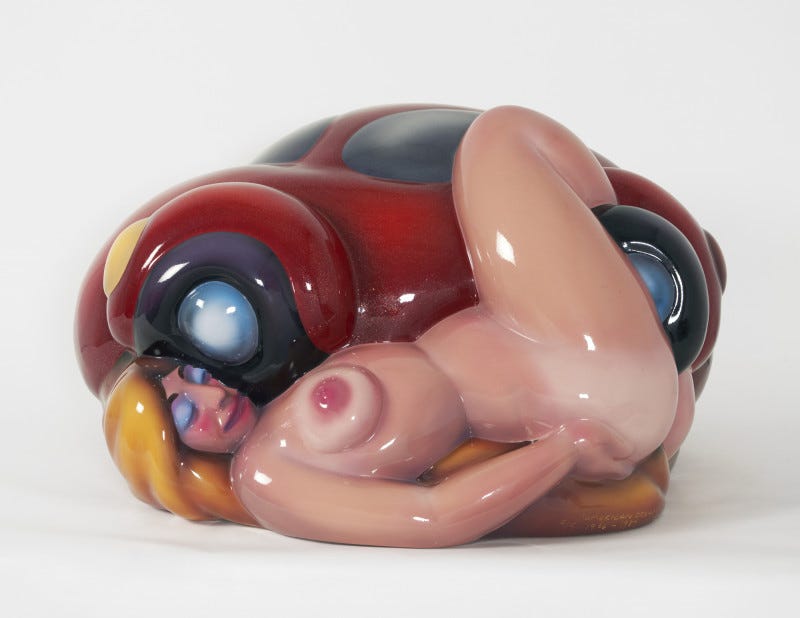
Luis Jiménez at Matthew Marks — through November 8th
In Camel #3 I wrote about Alex Grey, the painter of psychedelic figuration, and how his aesthetic philosophy roughly approximates my own aesthetic ideals. I tried to make the case that Grey’s work at its best pushes the viewer into in immediate state of aesthetic contemplation with varying levels of force and clarity, but ultimately surrenders too much to the dispensation of a didactic ideology, which cuts short a sense of enigma and mystery. The deeper purpose of that exercise was to try to get at what makes a work avant-garde and not simply kitsch. These questions emerged again for me at this show.
I was excited in advance to see this, knowing little about Jiménez’ work other than what was in the press release. The title and the bombastic images of polished, shiny, babes on motorcycles made it clear that, even if the art was bad, it was at least going to be fun, like Tom of Finland for straight dudes. The content and the material all suggest kitsch. And really, that’s all it is. But kitsch can be fun, especially when it lacks the pretense of being something more than it is. Maybe Matthew Marks would like to suggest that there’s something more here. It certainly has a more luxurious setting than a lot of kitsch gets. But putting costume jewels in a luxury setting doesn’t turn them into the real deal, even though with the right marketing it might raise their price. Nonetheless it is fun, and again raises the question for me of why Alex Grey hasn’t been given such a context. The drawings and paintings in the show have less depth and complexity, but are nice (except for the out of place large painting of the dancers). The sculptures are stranger, harder to imagine outside of a fine art context—though not by much.
Jiménez was a sculptor and painter from El Paso, Texas. Producing his sculptures in fiberglass with automotive finishes, the materiality feels more like Disneyland props than fine art. And many of his subjects invoke a quotidian Southwestern Americana mythos. His deeper influences range from the Mexican modernism of Diego Rivera and José Orozco, to the regionalism of American artists like Grant Wood, all oriented to legibility for the common viewer. I didn’t realize going into the show that I was already dimly aware of Jiménez. I am generally quite amused by extreme conspiracy theories, and exploring and indulging them is a guilty pleasure. Dean Kissick recently said they are modern folklore, which I agree with. They are organic kitchy mythological stories that sprout up from below to try to make heads or tails of modern experience. The Denver airport has a ton of mythos surrounding it, mostly suggesting it conceals a secret DUMB (deep underground military base) designed to protect the Fourth Reich global elite in the case of a global catastrophe. First, it is massive: in land it covers nearly twice the size of Manhattan, took years longer to build than expected, and went $2 billion over budget. Third; there is a Freemasonry dedication plaque in the main terminal that alludes to the “New World Airport Commission”, which does not exist (as far as we know) and the runways are built in the shape of a swastika. Finally it is infamous for hosting Leo Tanguma’s bizarre and unsettling murals in public areas (one of which Parker Ito recreated on the roof of LA gallery Smart Objects some years ago). But why do I bring it up? The airport commissioned a sculptor to build a gigantic, blue, bucking mustang with glowing red eyes to greet visitors arriving at the airport. Strange. Infamously, that enormous steel sculpture fell on its creator during production, killing him. That was Luis Jiménez. I didn’t know this until I stepped into the second gallery of the show, where a drawing of “Blucifer” is on view. Then it clicked.
The title of the show comes from a group of sculptures made by Jiménez in the late 1960s. American Dream depicts a nude woman making love to a red car. Its bold colors and cartoonish features are effortless and playful. Critic Dave Hickey dubbed it the “transmissionary position”. The content is lighthearted and funny, easy to enjoy. It is a campy and subversive depiction of 20th century American pop culture. That theme continues with Rodeo Queen, which depicts a woman seated with on a rocking horse with her arms back, looking down in fascination at the phallic horn of the saddle between her legs. Other than pithy indictments of American sexuality, Jiménez depicts American violence as well, in his Tank — Spirit of Chicago from 1968, which depicts crushed, nude, and faceless black bodies entangled around the chassis of a military tank, which also happens to look a bit like a Chicago hot dog. It is a condemning, brutal work, especially juxtaposed against the other more delightful subjects. It suggests a racially polarized society simultaneously capable of brutal state violence and commercialized sexuality. Then there’s my favorite, The Bomb. A play on words, the bomb depicts a “bombshell” busty, blue-eyed, blonde-haired nude woman as a nuclear mushroom cloud, all in a suggestively phallic shape. This succinctly epitomizes the themes of American sexuality and violence in a form that is a bit more formally oblique.
This is all to say that between the kitchy materiality and formal style; the clever and playful indictments of American sexuality and violence; and the connection to one of my favorite conspiracy theories, I was charmed by the show. But beyond that charm there is little depth. The content of the works reveals itself rather effectively, but with an immediacy that communicates everything right away, leaving little questions to linger on. It is entertaining, but not great art. Similar to Alex Grey, the work stops at a kind of didactics. It wants me to think something specific, but ultimately I crave works which deny this intellectual satisfaction, or at least complicate it with aesthetic choices that evade compact conclusions. Still though, a favorite visit in recent memory.
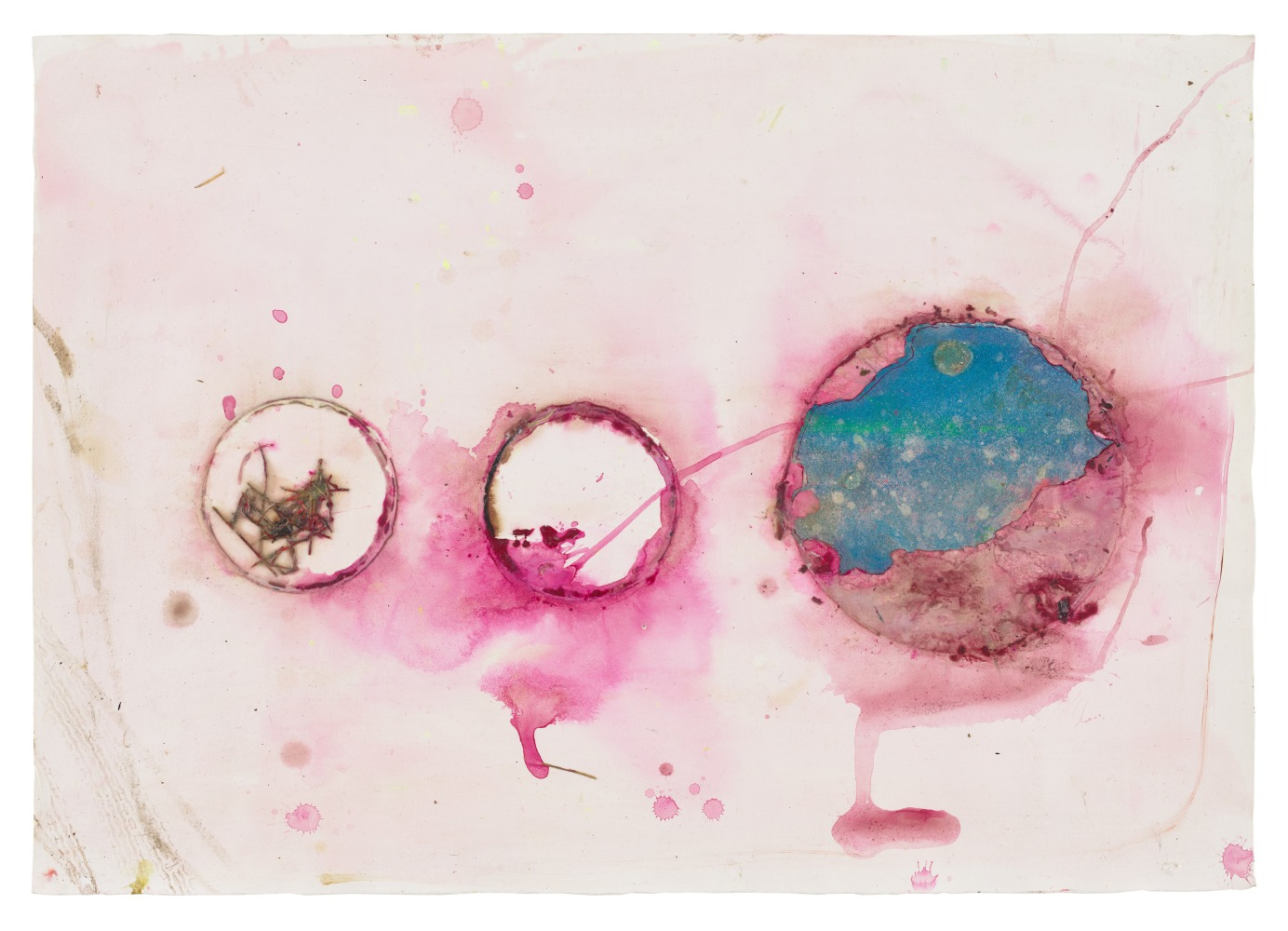
Frank Bowling at Marc Selwyn Fine Art — closed October 25th
Frank Bowling is an artist I’ve wanted to love for a long time. The only thing holding me back was my lack of in-person experience of his works. I heard late about his show with Hauser & Wirth a couple years ago, scrambling to the downtown gallery to see it on the last day, only to find out that the show was actually in the gallery’s West Hollywood location which was closing before I could make it across the traffic-ridden 101. Bummer. This works-on-paper show at Marc Selwyn’s Beverly Hills location is a start. I wanted to like his works because his works seem ahistorically direct, as did a number of the abstract painters in New York in the 1980s, including Jack Whitten, Terry Winters, Mary Heilman, David Reed, and others. But Bowling struck a particular chord for me because he seemed to complicate on my own ideas about abstract painting.
A phrase occurred to me while looking at these works on paper: residual abstraction. Hilton Kramer, who I shared a video of in Camel #3, first gained notoriety as a critic for his 1953 piece in the Partisan Review titled The New American Painting which ruthlessly attacked Harold Rosenberg’s 1952 essay Action Painting. To refresh your memory, Rosenberg’s action painting thesis was that the post-war abstractionists were demonstrating their psychology on the canvases as a form of documentation of action. For Rosenberg, these works were little artifacts of psychological events ready to be excavated by the equipped practitioner. Kramer (rightly) said he was an idiot. I dug it up for you, its really worth reading (jump to page 55 of Vol. 20 No. 4). Later in life he reflected on this disagreement with Rosenberg’s position, stating “it denied the aesthetic efficacy of painting itself and attempted to remove art from the only sphere in which it can be truly experienced, which is the aesthetic sphere. It reduced the art object itself to the status of a psychological datum.”
This is why Frank Bowling creates a sense of tension in me. His works are not action painting, of course not. But they could be a kind of detritus painting, or residual abstraction. I agree with Kramer whole-heartedly: Rosenberg missed the point of the post war abstractionists entirely. But Bowling’s works seem to be the heir to Rosenberg’s train of thought. They are literally the residue of studio life: the circles left from paint buckets, the dirt stuck to the surfaces, all these things collapse on the surface. They are like so many artifacts of a studio life. And yet, I feel their power as more than that. The works in this show are mostly on paper as the title describes, and so one might expect that they are even more debris-like than his paintings. And granted, in terms of their aesthetic power they are a bit all over the place, frequently boring and forgettable. But also there are poignant and stunning compositions. There are some that seem to go far beyond the rest. That dichotomy is deeply appealing to me as a viewer, it leads me to believe that the artist is working through real aesthetic issues, and is even inconclusive when it comes to resolving them. There is a challenge to the viewer, and a complexity to the experience that opens more doors than it closes. It forced me to reconsider what had hardened into my own aesthetic dogmas. Some are failures, but others succeed in unexpected ways. There is a life here that resonates powerfully and strangely.
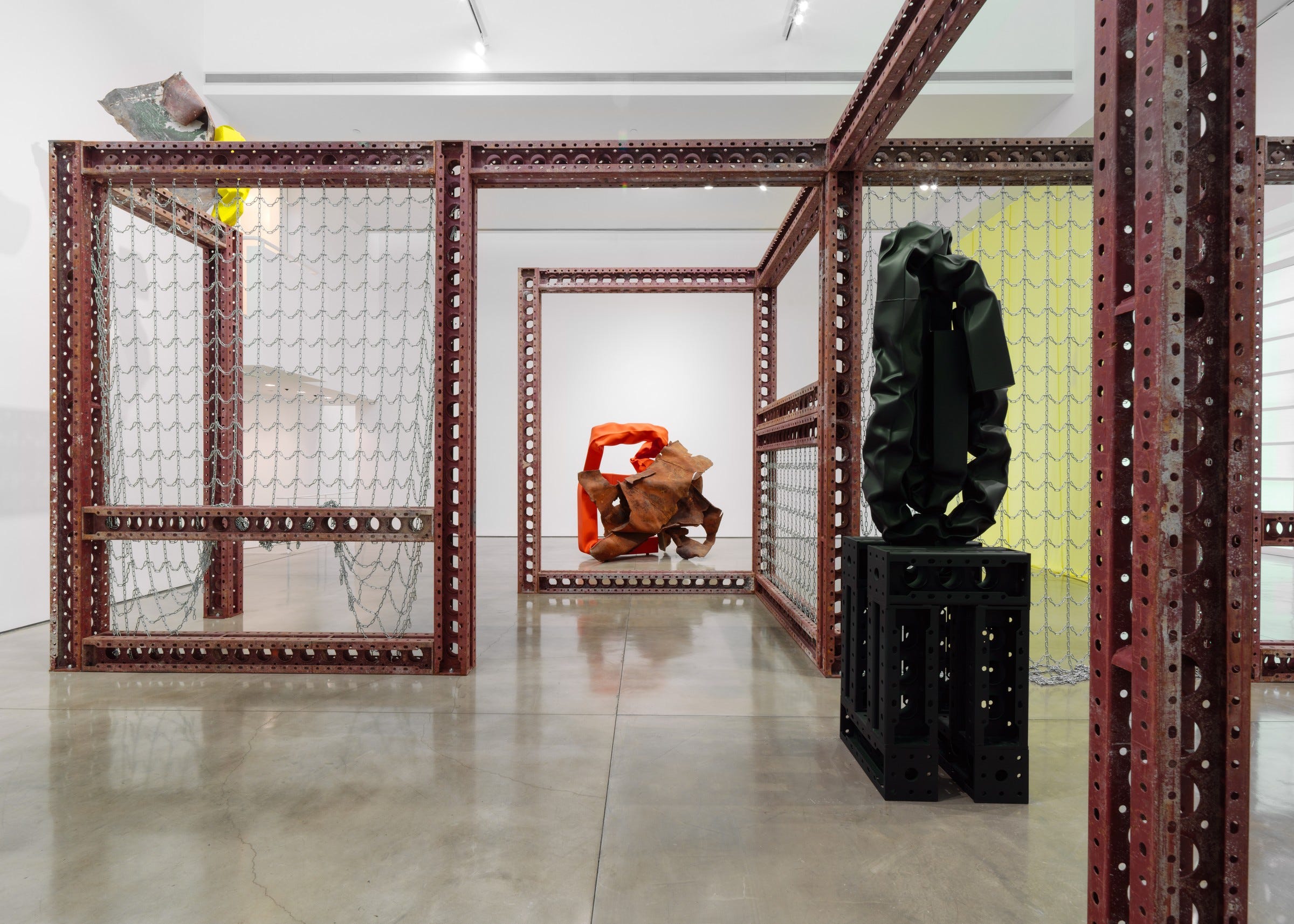
Carol Bove at Gagosian — through November 1
I went to all these shows with my friend, the artist Nicolas Shake. We wanted to see this in particular but made a day out of it. This show stood out because in Gagosian’s press release, its stated: “In Nights of Cabiria, Bove reflects on the industrial heritage of Los Angeles as a Cold War-era center for precision aerospace and weapons manufacturing, along with subcultural expressions of that focus such as surfboard production, with its devotion to perfect surface finish.” Shake’s work too is deeply invested in the history of Cold War Los Angeles, defense contractors, and local subcultures.
I have to say that the show itself seems really little to do with those interests. It’s also curious what Nights of Cabiria, the 1957 film by Federico Fellini has to do with it. Entering the gallery the viewer is confronted with a large yellow fabric partition, printed with a still from the 1913 epic by Giovanni Pastrone, Cabiria. In Fellini’s film, Cabiria a prostitute wandering the streets who comes up against the struggles of modern life. In Pastrone’s epic, Cabiria is a mythic heroine caught up in the world-shaping forces of mythical forces. Fellini was in dialogue with the history of Italian cinema, making a statement not dissimilar to that made by the Realist painters in 1850s Paris. The still Bove has chosen to print on the yellow partition is from a scene when Pastrone’s Cabiria is about to be sacrificed to Moloch. I must say that the immediate encounter of an image of the sacrifice of a young girl to a pagan God in the context of Gagosian’s Beverly Hills gallery felt… “site-specific”, to use the phrase of the press release. The modular industrial armature which framed and supported some of the sculptures was arranged to fit in the room, sure, but I’m not sure that makes the works themselves “site specific”. Anyways, the meaning of this film history overlay to the show remains generally opaque to me, which is not necessarily a detraction.
The first room of the exhibition is outfitted with a large industrial scaffolding (“soldier beams”), as mentioned. These beams form a skeletal armature dividing the room into sections. Amongst this skeleton, large metal sculptures are installed, I’m thinking here of Idiopathic Abstraction, for example. They are made of two parts: immaculately painted rectangular prisms, contorted into rippling and ribboning forms, juxtaposed against large, crudely distorted, rusty steel plates. These yin-yangs dance together, lean against each other, and form a rhythmic counterpoint in the works. Idiopathic Abstraction, with its orange steel tubes, is installed directly on the ground, and is framed by the soldier beams. Two other works in this room are painted bright yellow, matching the curtain at the entry, and installed directly into the beams, including one installed about 15 feet in the air. Another work in the room, Tied Light, departs from this strategy: it lacks the crude bent steel plate counterpart, consisting only of a mournful, black-painted wilting tube form mounted to an independent, matching black-painted soldier beam pedestal. This room is honestly breathtaking. The ambivalent sense of weight and weightlessness created by the materiality, the elevated sculpture, and by the leaning contortions is a primary source of that impression. In this regard quite it is reminiscent of the effects of some of Richard Serra’s works. Physically their production appears practically flawless. The raw contorted rusty steel on its own comes off as chaotic and volatile, but its contrast in the masterfully bent and painted tubes, a very complicated visual effect is achieved. There is something almost archetypal about the contrasts within each work. The feeling is something like a car crash and ballet at the same time.
In the next room are two more sets of sculptures. First is a group of 3 silver bent tubes on matching silver-grey soldier beam pedestals, each with a perfectly clean mirror disc mounted among its bent parts (see Similar Salamander). The bent steel tubes in these works exemplify this formal impulse to play with balance and weight in the shapes. They reach out from their pedestals with a greater sense of daring. The coiled sections of the compositions form counterweights both literally and compositionally. Tucked within these formal events, the mirrored discs, approximately 6 inches in diameter, come off like jewels. An obvious reference that came to mind is Jeff Koons’ blue orb paintings. And of course, like Koons’ orbs, Bove’s discs, each placed at roughly eye level, call to the viewer to view themselves. From here, inspired by the Moloch sacrifice introduction, I’d endeavor to make a spectacular, magical interpretation. The elements and forms composing the works seem to move from the absolutely crude and base, towards the perfected and ideal. From the brutality of the contorted raw steel plates to the delicacy of the of the reflecting discs: the transmuting of contorted, rusted steel into refined, geometric, silver. The alchemy ends here, however.
The final area of the exhibition features two smaller contorted orange tubes mounted to independent unfinished soldier beam pedestals (see Priestcraft). These feel like an afterthought, perhaps added to buttress the sales potential of the show. They are like studies for the other works. They are fine, but really not the substance of the exhibition, and, registered to me as a rather weak conclusion.
VIDEO
Inspired by the Carol Bove show, I’m sharing one of my favorite artist interviews I’ve ever seen, Richard Serra interviewed by Charlie Rose shortly after 9/11.
NEWS DIGEST
The Art Market Check by Melanie Gerlis. UBS.
Latest from Kenny Schacter. ArtNet.
After a 12 Percent Drop in Global Art Market Sales, Collectors Bet on Stability Over Speculation by Daniel Cassady. Artnews.
How Christie’s and Sotheby’s Plan to Remake Their Fortunes by Tim Schneider. Business of Fashion.
Art and fashion: are they still aligned? by Francesca Gavin. Financial Times.
Pace Gallery and Perrotin are closing their galleries in Hong Kong – for now by Genevieve Pang. TimeOut.
Hauser and Zwirner’s UK Galleries Report Nearly 90% Drop in Earnings by Maya Pontone. Hyperallergic.
Which Country’s Art Market Came Out On Top in the First Half of 2025? by Margaret Carrigan. ArtNet.
Basel Paris
At Art Basel Paris, the art world shows no sign of crisis by By Roxana Azimi and Harry Bellet. Le Monde.
Ascendant Art Basel Paris rewards top dealers, while smaller galleries compete for attention by Kabir Jhala. The Art Newspaper.
Big-League Fare Sells at Art Basel Paris, as Dealers Eye Recovery by Margaret Carrigan. artnet.
Art Basel Paris’s Avant Première Becomes De-Facto VIP Opening, With the Attendant Eight-Figure Sales by Devorah Lauter and Sarah Douglas. ARTnews.
State of the Art Market Today: Why Q4 2025 Could Mark a Definitive Shift in Global Art Market Trends. Maddox Gallery.
Frieze London
Frieze London 2025: Big Galleries Report Strong Early Sales, Topped by $850,000 Rauschenberg and $950,000 Ellen Gallagher by George Nelson. ARTnews.
Frieze London Restores Market Confidence and Outsells Expectations by Elisa Carollo. Observer.
Frieze London & Frieze Masters 2025: Sales, Trends & Market Insights by Sheena Carrington. MyArtBroker.
London Isn’t Lost: Frieze 2025 and Beyond by Carolina Zemma. Made in Bed.
How Young Collectors Are Reshaping London’s Art Market by Tom Seymour. Ocula.
Fear and loathing at Frieze by Orlando Whitfield. Observer.