

CAMEL #4 (part two)
Reviews of Herman Cherry at Sebastian Gladstone, Alex Heilbron at As Is, Josh Smith at David Zwirner, Calvin Marcus and Manoucher Yektai at Karma... and some recommendations and news digest
Hi,
Welcome to the second part of the fourth letter of Camel, my newsletter covering a variety of art-related and Grant-Tyler-related topics. Part one contains my over-elaborate market analysis and a video from Allan Schwartzman. This part two is a handful of reviews and recommendations.
I hope you enjoy it. I deeply value the feedback of my readers and hope that Camel can help spark conversations about what we can do differently as artists, dealers, writers, etc to support an improved artistic environment. Don’t hesitate to comment, message, or join the chat.
REVIEWS
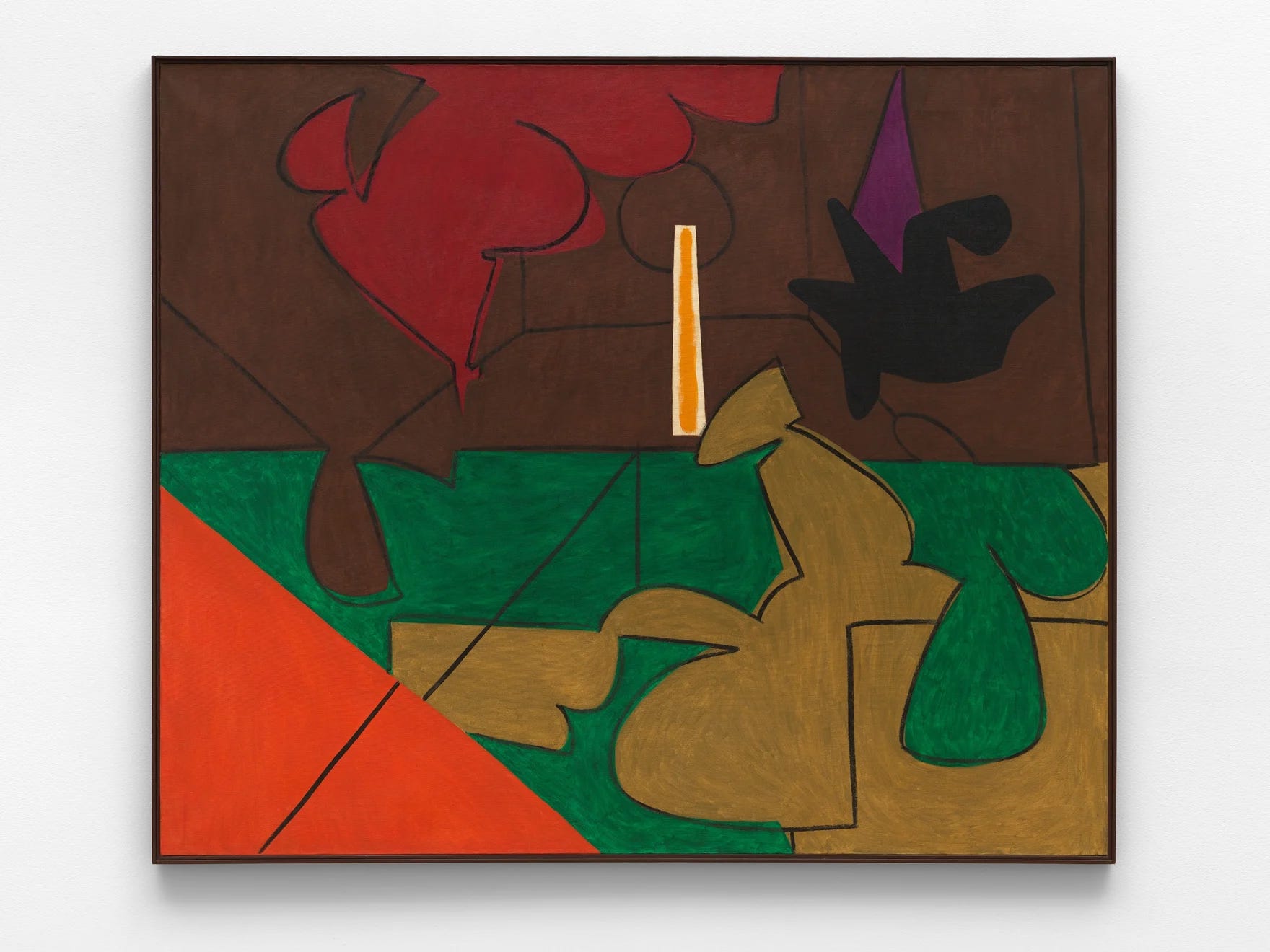
Herman Cherry at Sebastian Gladstone — through October 25th, 2025
Gladstone is presenting “A Different Kind of Abstraction”, a group of 10 or so paintings by the little known Herman Cherry from the 1960s, who, despite having LA roots, was active in the postwar New York painting scene. This is the first estate Gladstone has represented and the exhibition inaugurates his new location on Santa Monica Ave in the old Reena Spaulings/Gaga gallery. There is something to be said about Gladstone’s talent as a dealer. Some of what could be said was said in ArtNet earlier this month. In sum, his ambitions have served him well as he has meteorically risen in prominence since founding the gallery in 2020. Amid a backdrop of sales strife, closures, and market uncertainty, Gladstone has demonstrated an exceptional resilience. I’ll mention that he is a friend of mine, and I’ve worked for him here and there. But the fact of his ambition and success is undeniable.
As for the Cherry show, it is genuinely mesmerizing. Cherry’s works feel very fresh, very solid, and very simple. There’s good art, and then there’s good efficient art, and this is definitely the latter. Cherry marks out abstract shapes on his canvases in a cozy earthen palette. The boundaries of these forms are loosely underscored by robust charcoal lines weaving over the surfaces. The black lines are a kind of graphic stroke which loosely and organically echoes the forms below. The imprecision of their relationship to the boundaries of the colored shapes beneath generates a casual jazz-like feeling, sort of like playing behind the beat, pulsing in and out of phase. Overall the works emphasize their frontal flatness, characteristic of the New York school of that era. They have a graphic character, like zoomed in panels of comic strips. They seem to contain information, but yet remain in a liminal zone of abstract contemplation.
A cursory glance at some of Cherry’s works from other periods of his career reveal an artist open to transforming his approach to painting in dramatic ways. In some works there is a stronger taste of his contemporaries like de Kooning or Kline. But with the present body of work at Sebastian Gladstone, there is a character that is both ambitiously representative of the concerns of avant-garde painting from that era and yet singular in its expression.
The feeling I have is that the exhibition was generally well received. How odd it is that a relatively unknown Ab-Ex painter would find such a warm reception in Los Angeles in 2025? Gladstone’s press release suggests that Cherry (who went to New York from LA in 1930) began to find success as a figure in the Ab-Ex scene at just the moment that Pop was rendering abstract painting passé, hence his failure to achieve greater status and prominence in the American painting canon. To put a fraught issue bluntly, Pop marks the beginning of a shift in Western art from modernism to post-modernism. That shift inaugurated the epoch of Contemporary Art, which stubbornly persists to our time, but, as I have written here and elsewhere, is experiencing the slow and steady erosion of its ideological (and financial) foundations. It is hard to imagine an exhibition like this taking place successfully 15 or 30 years ago. Either way, for an ambitious young gallery to successfully launch their hometown expansion in the 21st century with an artist from a previous epoch is symptomatic of Contemporary Art’s loosening grip.
I used to joke that the reason for the particular hatred of so-called “zombie formalism” was that the boomers’ youth was defined by the deliberate killing off of the abstract painting of their parents, their middle age was spent gleefully in the realm of post-modern Contemporary Art, and yet, finally, as retirement appeared on the horizon, their kids began to pull frontal, expressionistic abstract paintings out from under the mattress, and resurrect it to their own ends. How irritating that must’ve felt! While I don’t necessarily imagine this exhibition to alienate the boomers, I can imagine New Yorkers scoffing at LA’s addiction to beautiful paintings. The truth is that today, abstract painting offers no inherently better or worse chance at producing a radical and compelling aesthetic experience than alternative neo-avant-garde approaches. At the end of the day these are compelling and powerful works with plenty to offer by way of lesson and inspiration for today’s artists and viewers.
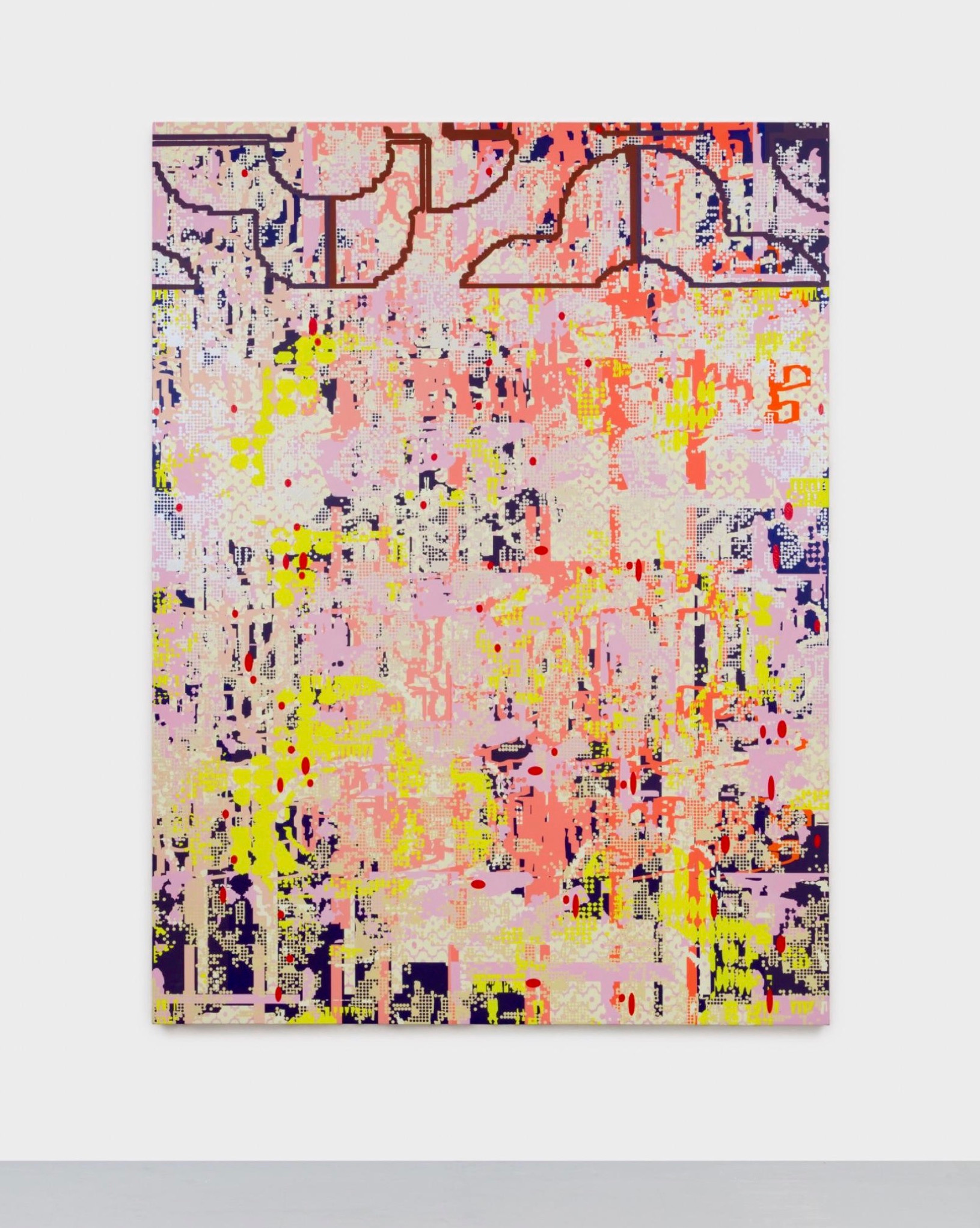
Alex Heilbron at As Is — through October 25th, 2025
Heilbron is an LA based painter working with patterns and stencils to produce richly dynamic abstract canvases. The process involves the appropriation and digital remixing of design patterns, specifically from 20th century Austria, and employing them as screens that layer color onto the canvases’ surfaces. In previous works these layered abstractions also included some more tangible elements such as figures and text, but in All Systems Fail, those are removed to focus on the rhythms of the abstracted patterns.
Heilbron works by meticulously editing found patterns in the computer and using them to generate stencils. One stencil at a time is placed over an initial underpainting, and layers of paint are built up one after the other, the patterns overlapping and interacting in unpredictable ways. Ultimately this produces networks of color that vibrate against each other. In The Tools Dig Deeper (Grid), Heilbron rhymes deep blues with a creamy yellow and salmon color. The final minimal layer is rendered in a starkly contrasting firetruck red which floats above the other meshed layers. This strategy with color produces a sense of elevation between the forms. And this sense of elevation, along with the tightness or looseness of the meshed layers fluctuates throughout individual works and more significantly between the works. The best paintings are those which orchestrate density with irregularity. I’m thinking of The Process of Putting (Pink), where there is a far more pronounced irregularly of interplay between the layers and color schemes. This painting also appears to have a far greater density of information, perhaps due to more layers (I count 9 or 10, as opposed to 4 on The Tools Dig Deeper [AntiGrid]). I’m not sure the answer here is simply a linear thing, whereby aesthetic power is created by interplay of layers, therefore more layers = more power. I do think the color dynamics, the variations in the tightness or looseness of the layers, and the amount of rhythmic repetition each play significant roles in the overall persuasiveness of the paintings.
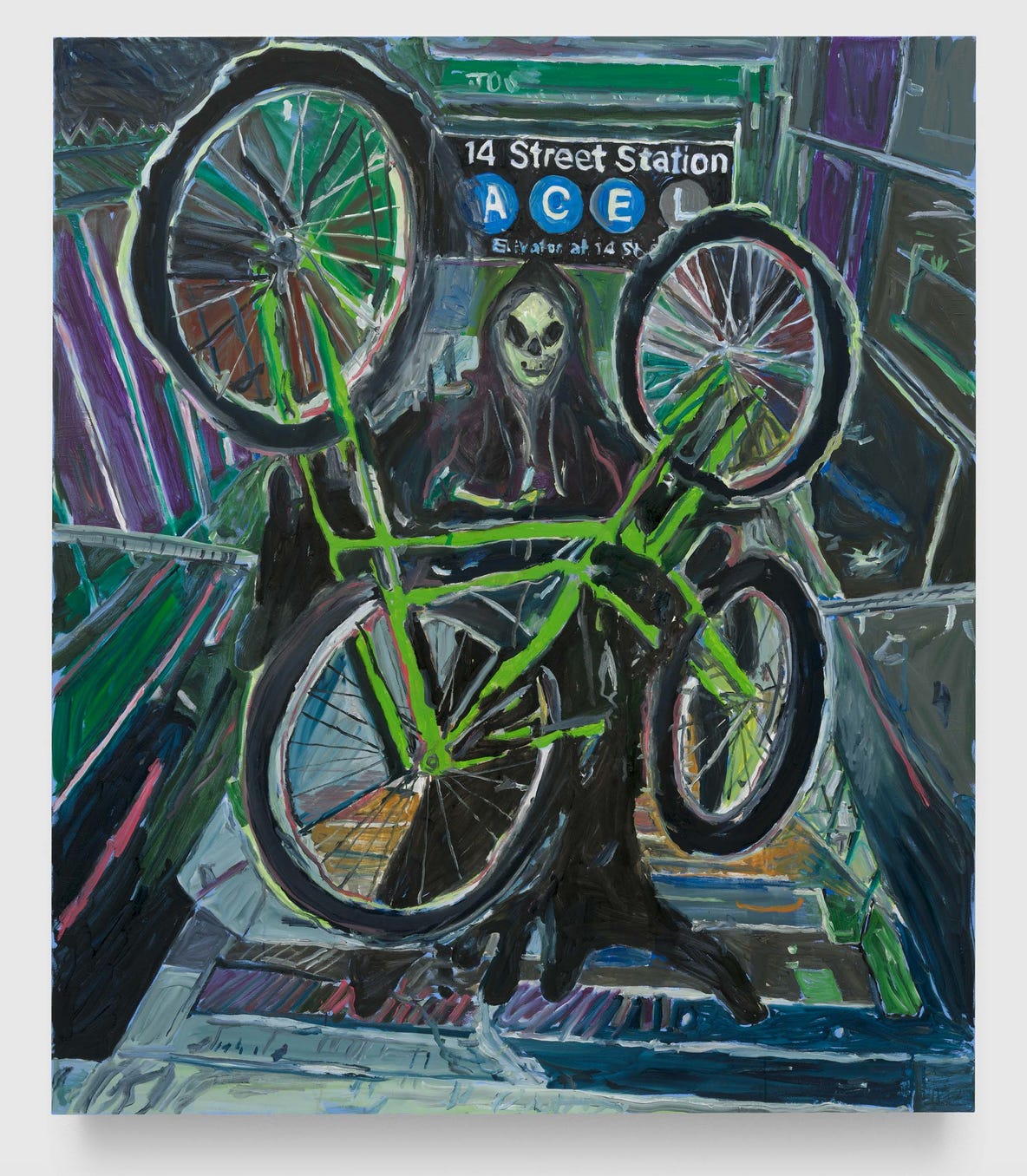
Josh Smith at David Zwirner, LA — through November 1st, 2025
Zwirner opens the season in LA with a modest show of new works by prototypical Gen X slacker Josh Smith. 19 paintings and one sculpture make up Smith’s first LA solo show. All of the works take the grim reaper as the subject, and all of the paintings involve the grim reaper riding, holding, or crashing a bicycle. They are crudely painted, characteristic of Smith’s practice. They are easy for me to enjoy but hard for me to take seriously as great art. But to be generous, I don’t think that’s really Smith’s goal. As I said, I think Smith represents the slacker image of his generation, like the band Pavement or Linklater’s film. It’s this broad cultural stereotype resulting from that generation’s apathy contrasted against the idealism and ambitions of the boomers that Smith embodies. And I can’t help but find it comfortable and relatable. As is evident from this issue of Camel as well as my previous issues, I have a bit of a bone to pick with Contemporary Art, which I see as a definite epoch of artistic production with definable ideological dogmas that result from boomer ambition in the fine art. So I must admit to being charmed by an artist who has become quite successful all the while belying a shrugging “whatever” towards the institutions and ideals of Contemporary Art.
I’ll emphasize I don’t think this is great art. I don’t even know if it’s good art. But still I liked it. This work carries forward the “High as Fuck” paintings of empty New York streets painted during the COVID pandemic and marries them with his long-standing grim reaper motif. During the lockdowns the streets became empty. And then the reapers began to roam. The bicycles are absurd. The wheels seem more important than the frames (fitting as the grim reaper is modeled on the Roman god Saturn, who is the god of death, the harvest [hence the scythe], and time [hence the wheels]. Saturn [Chronos to the Greeks, where we get “chronology”], is the perpetual devourer, symbol of cosmic cycles of annihilation). It is doubtful that this level of symbolism is intentional, but could be. As a viewer it adds a layer of contemplative material for me, but does not remedy the overall shortcomings of the works as art.
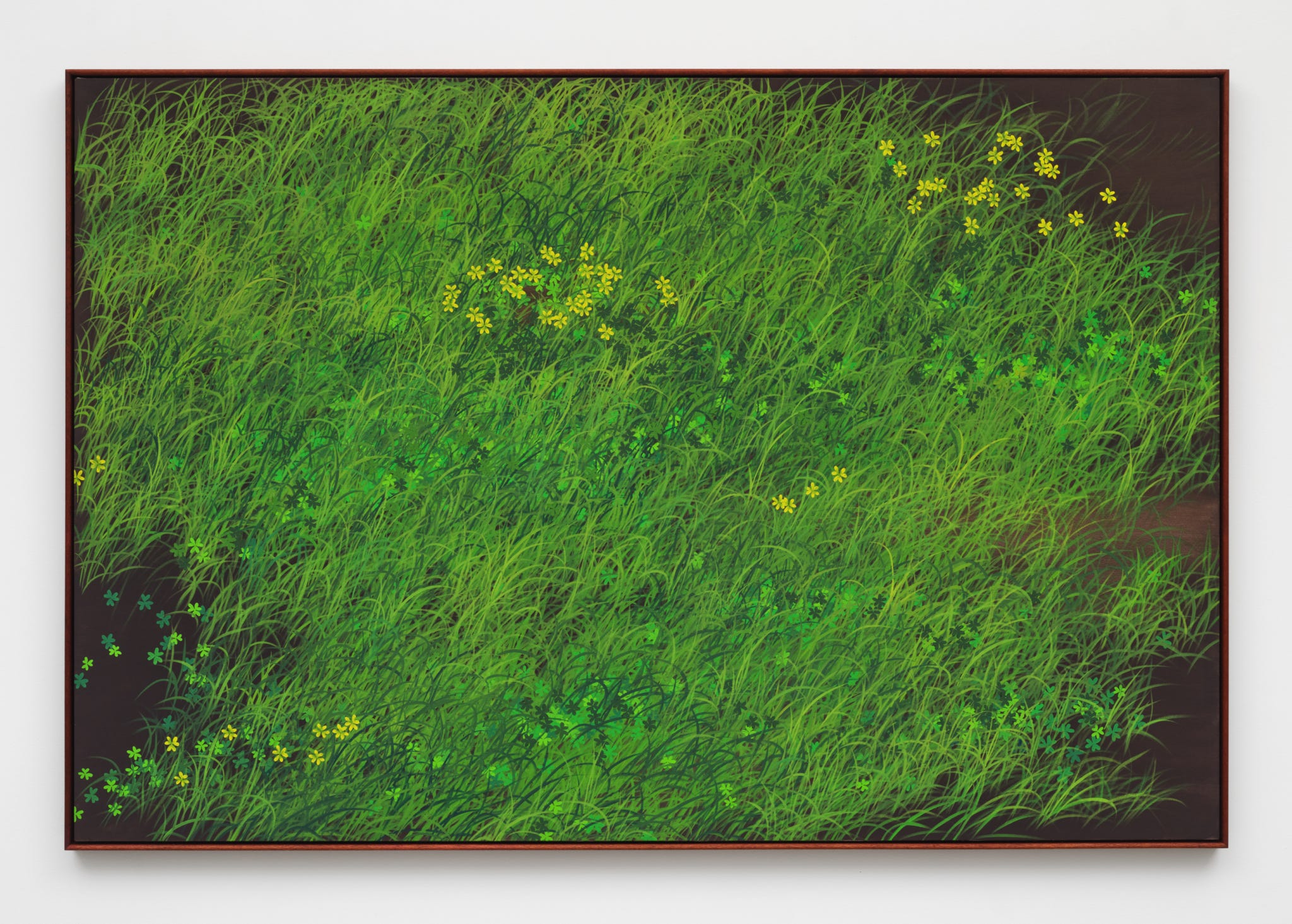
Calvin Marcus at Karma, LA
It is time to touch grass. I was shot by the Karma security guard for petting these paintings with my crumby greasy hands. I thought these were lukewarm paintings. Its a group of seven paintings of layers of green grass on dirt backgrounds. They seem to be built up layer by layer, some with undulating dirt beneath, others with clovers, some clovers obscured by blades of grass, others poking through surface in moments of gratifying change amidst the rather monotonous green strokes. Not particularly moving. They are underwhelming, if I’m being totally honest. I wanted to like them more that I actually did. They are pretty.
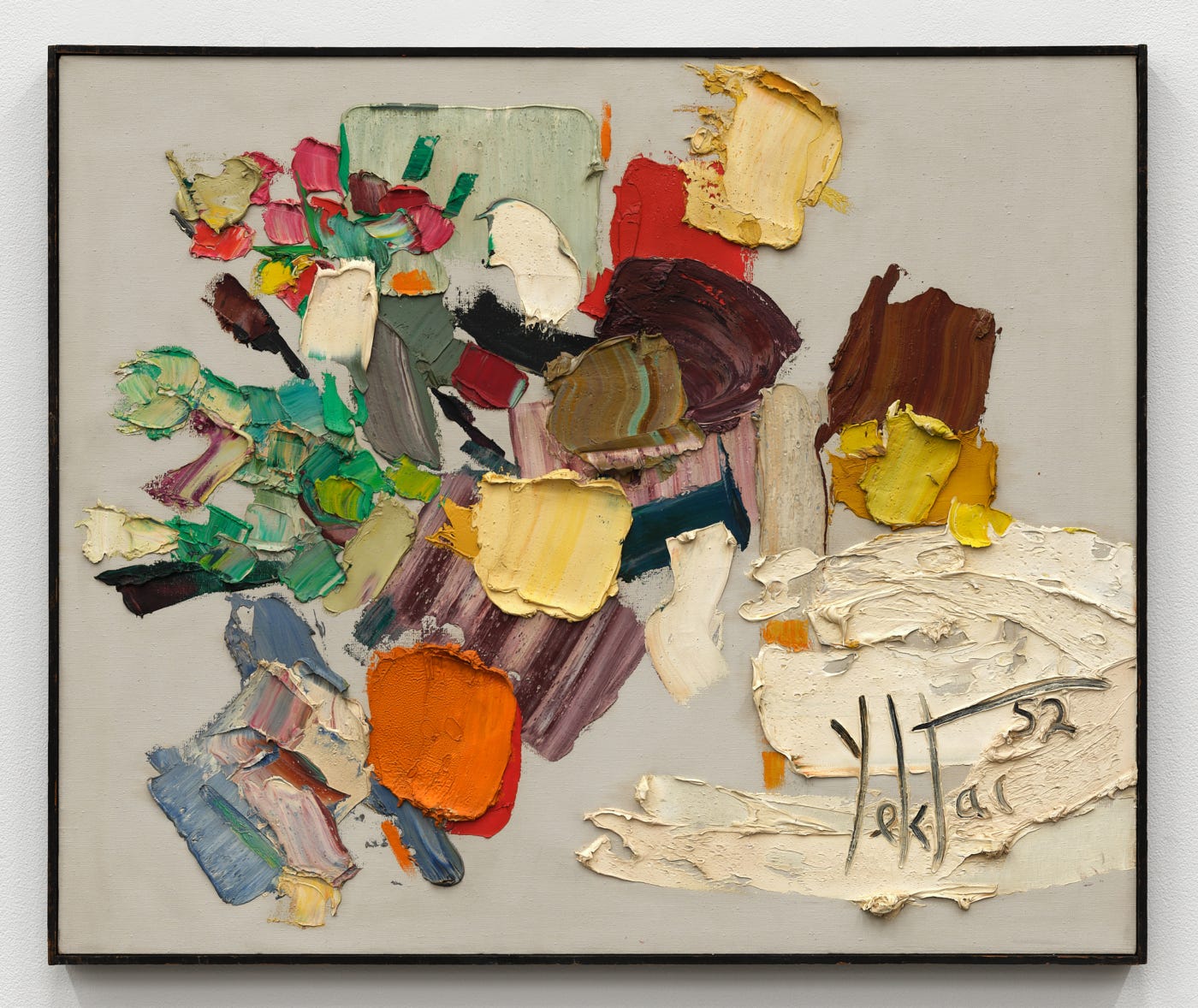
Manoucher Yektai at Karma, LA
I came to Karma for the Calvin Marcus show but this blew me away. It’s interesting that another gallery is opening the season with the estate of a lesser known abstract expressionist/New York school-adjacent painter. Karma did show Yektai in New York in 2021 and Yektai did achieve some recognition in his lifetime. But generally he’s lower profile.
But a lot of these paintings are really just gorgeous. And some not so good. For the sake of brevity, I’ll let Karma tell you a bit about his background. The works overall are painted in thick impasto pushed around like vibrant clay, often on chic flat grey backgrounds. The saturated colors and the built up the surfaces with material makes them feel rich, heavy, thick, and physical. Superficially this kind of work should feel kitchy, like it could hang in a mediocre hotel lobby. But it genuinely doesn’t to me. It feels masterful, historic even. It reminds me of my love for the freedom and authenticity in Cy Twombly’s canvases. I am a sucker for Clement Greenberg, I do feel that quite a bit of his attitude defining my own experiences of art. Here too I’m reminded of an essential distinction he made that goes under recognized. From his most famous essay Modernist Painting (written 1960):
“Abstractness, or the non-figurative, has in itself still not proved to be an altogether necessary moment in the self-criticism of pictorial art …”
and…
The latest abstract painting tries to fulfill the Impressionist insistence on the optical … But this kind of consistency promises nothing in the way of aesthetic quality … ”
And also from Abstract, Representation, and so forth…(written 1978):
Experience, and experience alone, tells me that representational painting and sculpture have rarely achieved more than minor quality in recent years, and that major quality gravitates more and more toward the nonrepresentational. Not that most of recent abstract art is major; on the contrary, most of it is bad; but this still does not prevent the very best of it from being the best art of our time.
And finally…
To hold that one kind of art must invariably be superior or inferior to another kind means to judge before experiencing; and the whole history of art is there to demonstrate the futility of rules of preference laid down beforehand: the impossibility, that is, of anticipating the outcome of aesthetic experience.
I quote from him at length to underscore a few things, and my apologies to Yektai for feeling the need to invoke Greenberg in this review. First: experience is everything. Prejudgements mean very little in the realm of art, because art rests on the experience of looking honestly and openly. I had prejudgements when I walked in the door that I would love Marcus’ show (I do like his work), but my honest experience was otherwise. This exhibition on the other hand was quite a pleasant surprise, and turned out to be a favorite in recent memory.
Secondly: there is a post-modernist linear historical misconception about modern art in general and Greenberg in particular that they believed good art was art that did something new and different. I think these quotes do well to dispel that myth, for, on the contrary, Greenberg argues here that all art must be judged by the experience one has of it, not by preconceived notions about its medium or style or strategy. Greenberg’s fondness of abstract art, he clarifies, was not due to its being abstract, but due to the curious historical condition that meant much of the good art being made in his time happened to be abstract, not to mention his compulsion to defend it against detractors who were judging it based on preconceptions about formal traits and not their immediate experiences. This last part is additionally important in the context of Yektai’s works since they are not the puritan’s abstract expressionists paintings. Rather Yektai has sought to achieve artistic quality through the “optical”effect of modernist methods of paint application and artistic self-reflectivity, without abandoning pictorial depictions of real world objects and spaces. It is his ability to leverage this duality picture by picture that factors in the show’s overall effectiveness. The flower works are utterly spellbinding, probably the standout for me.
Smells Like Girl at Jeffrey Deitch
This was pretty bad. Deitch knows how to draw a crowd: big rambling group show with a broad net of themes and media and a large dollop of sexual perversion. I did find very compelling a sculpture in the very back: a silver woman’s arm rested on a pedestal with long fiery orange hair extending from the armpit and holding three marble eggs in her palm. I’m almost certain this was by Isabella Albuquerque but I could not confirm. But this was nearly hidden behind atrocious works here and boring works there.
THINGS I’D LIKE TO SEE
LA
Sam Gilliam at David Kordansky
Luis Jimenez at Matthew Marks
Rebecca Warren at Regen Projects
NYC
Elizabeth Englander at Theta
***this looks unbelievably awesomeChristopher Kulendran Thomas at Gagosian
Richard Serra at Gagosian
Dominique Knowles at Greene Naftali
Kira Scerbin at King’s Leap
Olivia van Kuiken at Matthew Brown
EUROPE
Lutz Bacher at the Astrup Fearnley Museet, Norway
The Astrup Fearnley Collection at the Astrup Fearnley Museet, Norway
NEWS DIGEST
Is the Gulf Art Boom a Mirage? — Phin Jennings, Air Mail, September 6, 2025
What Sotheby’s $136 Million Karpidas Sale Reveals About the Market — Margaret Carrigan, Artnet News, September 19, 2025
When Gagosian Goes So Do His Galleries, How Hockney’s Swimmer Swam Away, and Green Shoots in the Gallery World — Kenny Schachter, Artnet, September 22, 2025
New Collectors Drive Strong Sales at New York Fair 2025 — Daniel Cassady, ARTnews, September 2025
As Fall Art Season Opens, New York Galleries Stay Stubbornly Optimistic — Harrison Jacobs and Daniel Cassady, ARTnews, September 3, 2025
Christie’s to Sell Rare Hockney Portrait of Christopher Isherwood — Melanie Gerlis, Financial Times, September 17, 2025
The Art Market Is Struggling Everywhere. But in Japan and Korea, There Are Reasons for Optimism — Vivienne Chow, Artnet News, August 26, 2025
From Slump to Surge: 7 Trends Reshaping the Art Market — Anny Shaw, Art Basel Stories, September 19, 2025
The Art Market Check 2025 — Melanie Gerlis, UBS, June 5, 2025
Art Market 2025: Why Growth at the Lower End Is Redefining the Industry — Sheena Carrington, MyArtBroker, August 6, 2025
Armory Show VIP Opening: Early Sales and New Buyers in New York — Carlie Porterfield, The Art Newspaper, September 5, 2025
The U.S. Will Send American Art to a Global Competition. How MAGA Could It Be? — Maura Judkis & Kara Voght, Washington Post, September 18, 2025
Mid-Year 2025 Artnet Intelligence Report: The Storm Hits the Art Market — Katya Kazakina, Margaret Carrigan, Vivienne Chow, Annie Armstrong; edited by Naomi Rea, Artnet News, September 9, 2025
Tanya Bonakdar Gallery to Close Its Los Angeles Location — Carlie Porterfield, The Art Newspaper, August 20, 2025
LA Louver to Close Its Venice, California Space — Jori Finkel, The Art Newspaper, September 16, 2025
Hannah Hoffman and Bridget Donahue to Merge — Alex Greenberger, ARTnews, September 10, 2025
Is the Doom-and-Gloom Coverage of the Art Market Fair? — Daniel Cassady, ARTnews, September 10, 2025
The Storm That Reshapes: Galleries, Auctions, and Collecting — Amelia Tomasicchio, Econique, 2025
Rising L.A. Dealer Sebastian Gladstone Expands — Tim Schneider, The Art Newspaper, August 27, 2025
The Slow Death of the Contemporary Art Gallery — Keith Estiler, Hypebeast, August 15 2025
Forget Blue-Chip Art: It’s a Red-Chip Art World Now — Annie Armstrong, Artnet News, March 13, 2025
The Art Market Has Lost Its Grip on Price — Naomi Rea, Artnet News, June 13, 2025