

CAMEL #2 (part 2)
Interview with Maggie Friedman
Hi!
This month I’ve split Camel into two parts because Substack wouldn’t let me do it all at once (too long). I would recommend that you go back and check out Camel #2 (part 1) if you haven’t read it, but this part 2 is by no means contingent on the content published there.
Maggie Friedman is an artist I’ve been visiting with for a couple of years now. Since 2023 she has been painting other paintings (for instance works by Silke Otto-Knapp, Sean Scully, Neo Rauch, among others) with a single color of paint, Kama fluorescent green. This practice has deeper roots in connection with her writing and, as we discuss in this interview, these two media are frequently generating and reflecting one another. I curated her into my 2024 exhibition Sprezzatura at As It Stands in Los Angeles. Friedman’s recent solo exhibitions include 7 Paintings at Shoot the Lobster, 2023 in New York City, Alibis at As It Stands, 2024 in Los Angeles, and she has a two person show with Ammon Ngakuru at Coastal Signs in New Zealand later this year, which she is working on alongside her second novel, to be published with Apogee Graphics. Her first novel, minimally titled Novel, is available here.
INTERVIEW
Grant Tyler: Let’s start with Shoot the Lobster?
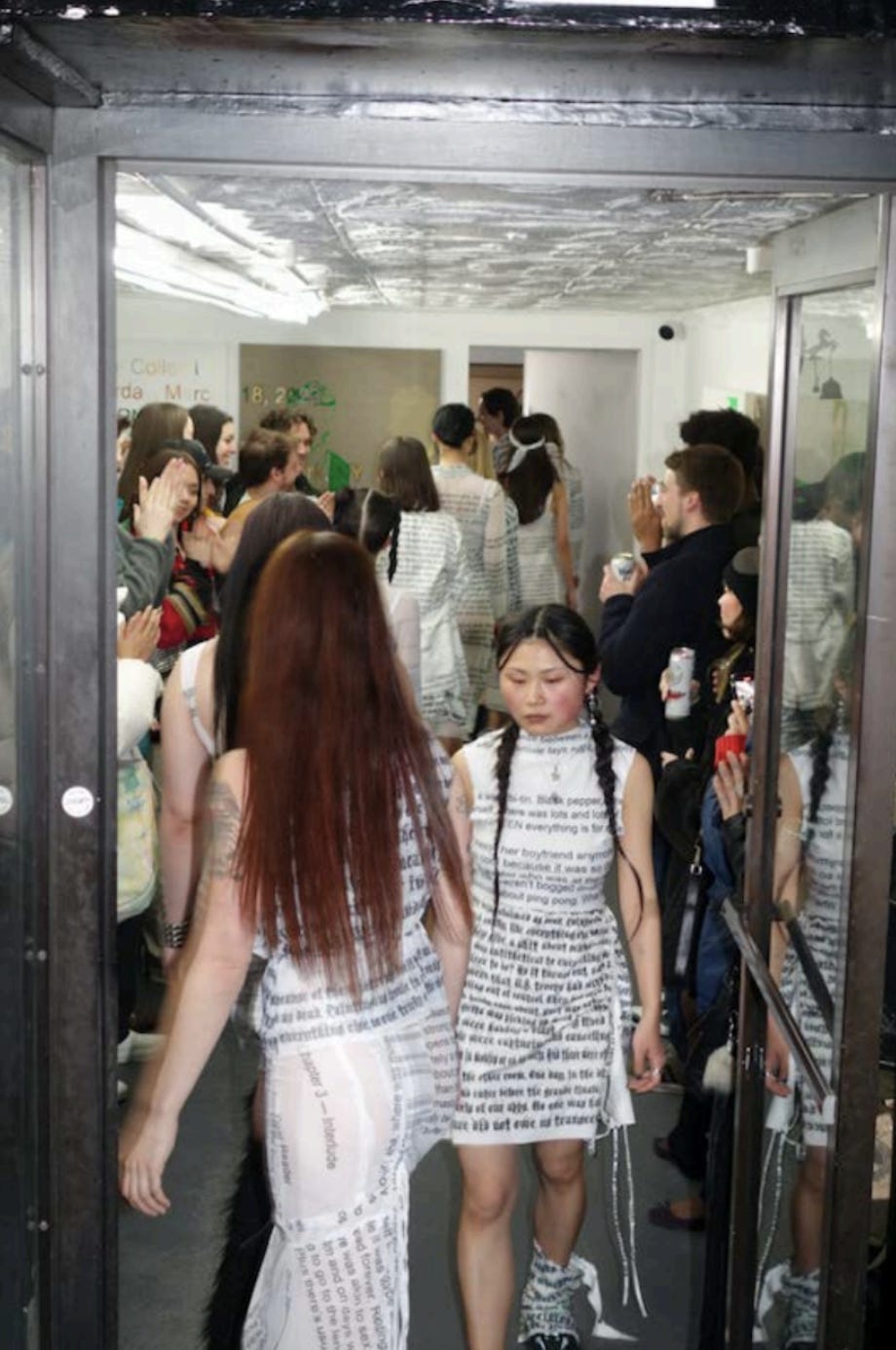
Maggie Friedman: The Shoot the Lobster work came from my thesis show so that’s a better place to start. I graduated with my MFA from Art Center in 2022 and my thesis was a combination of three elements which stemmed from writing a book I self-published called Novel. Novel was a blend of various appropriated texts but mostly took from the narrative of Reena Spaulings by Bernadette Corporation. It was a somewhat updated version of that book which meant that it was set in LA in 2022 and, instead of following Reena, followed a girl painter getting an MFA. The main character was working on her thesis and also contemplating fashion and writing. In conjunction with self publishing that book I made a body of paintings which illustrated the book, and a fashion collection, which I cut and sewed out of fabric printed with the text of the book.
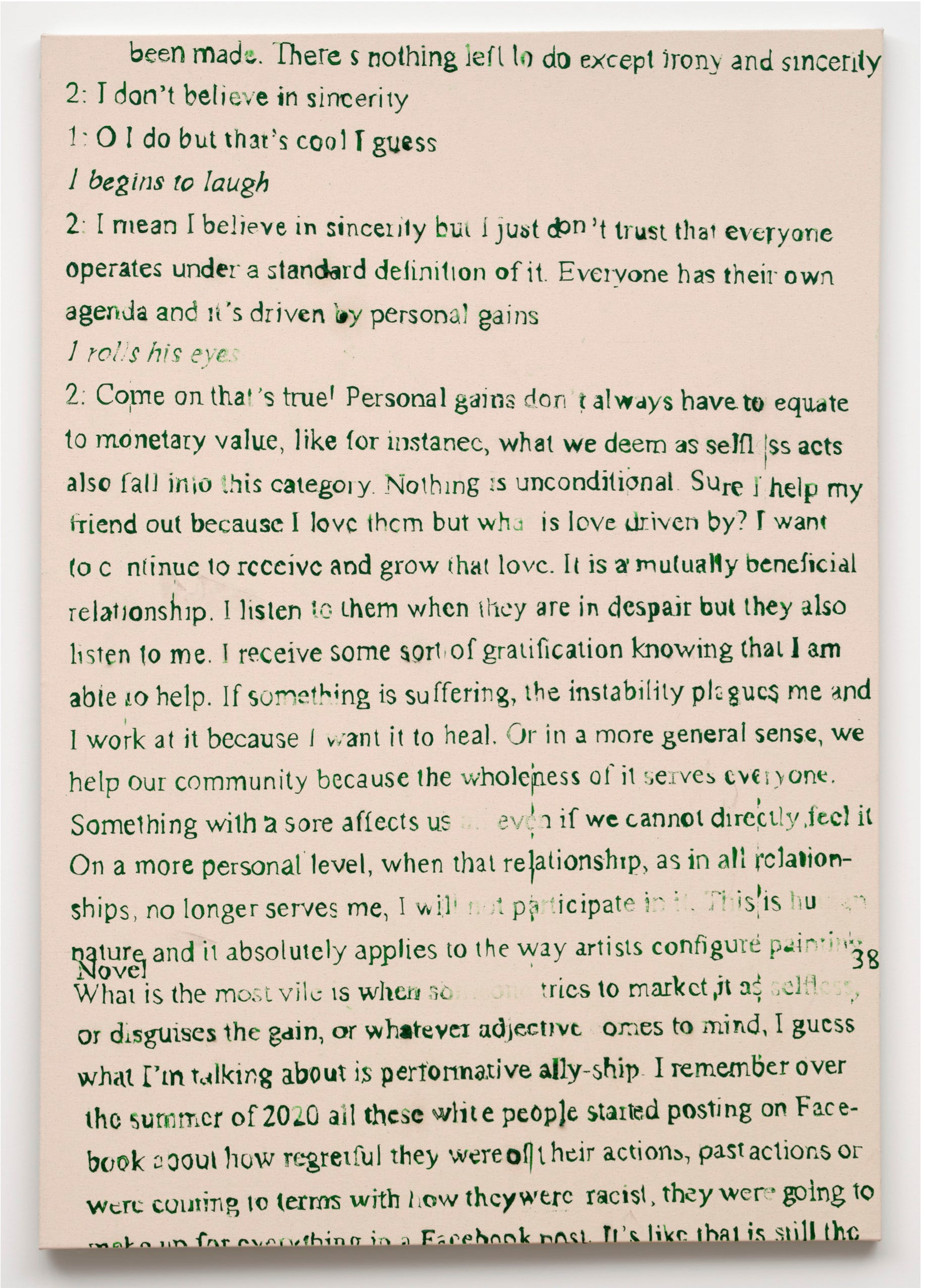
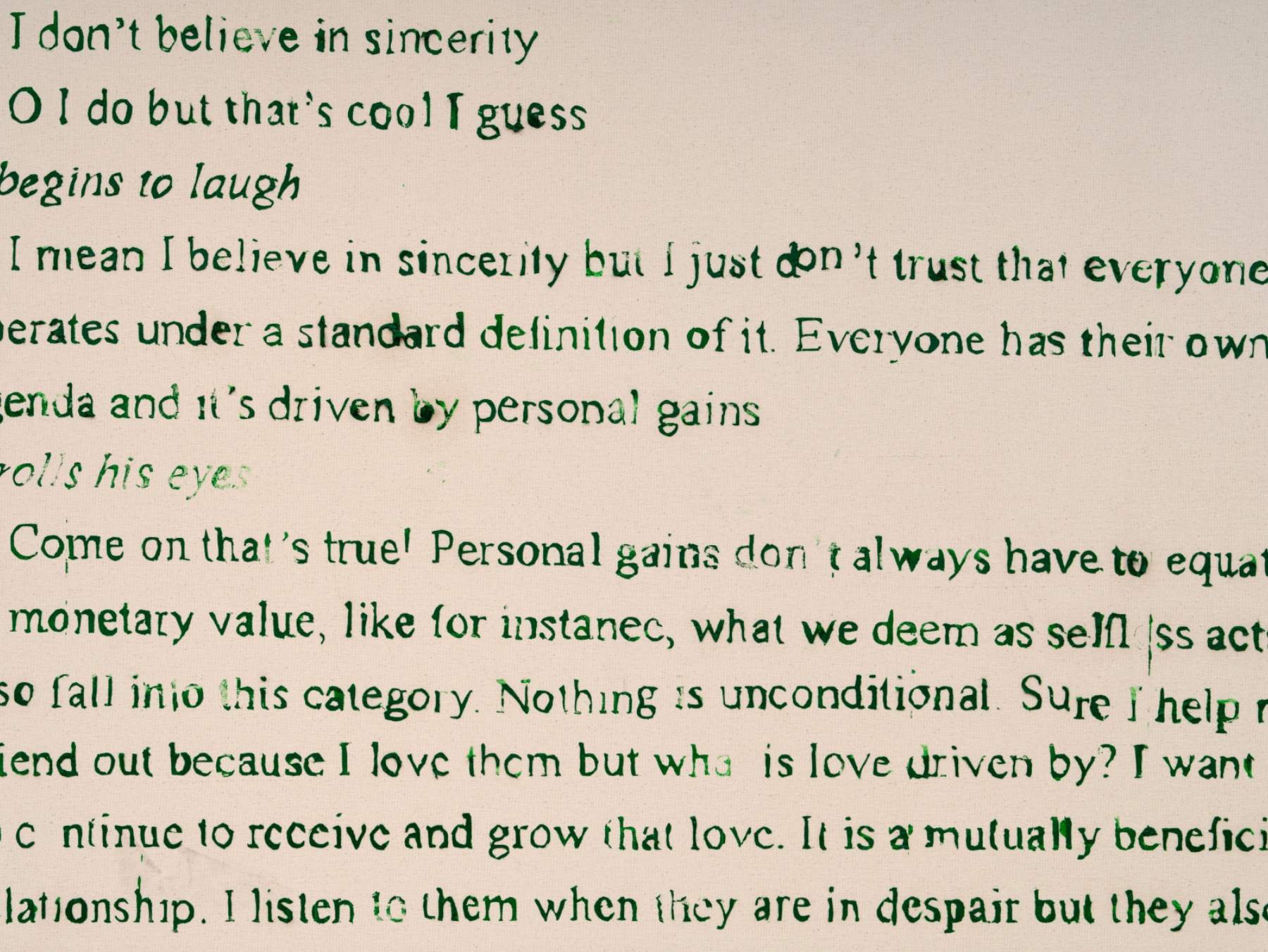
Some of the paintings were a visual representation of things I wrote about in the book like a Susan Cianciolo show I saw at Overduin and Co in LA and some were painted text of chapters. Some of the text paintings ended up being early first drafts of the book which happened because I was working on everything simultaneously, so the writing in the novella got updated after the paintings were finished. At the same time I made the fashion collection, around 50 pieces which I showed during thesis open studios. The models walked through the hallways of my graduate program, that was the runway. In the Shoot the Lobster show I appropriated all of this. The idea was a show of paintings that were an advertisement for my thesis work but I changed the palette. It was metallics and the same green. The metallics idea had something to do with signaling wealth, like gold-plated hardware.
But all the paintings in that show were ads of some sort. I redid a painting from my thesis show, I painted the models wearing the clothes, one of the paintings was an email address for a service I wanted to offer to writers where they could test their writing by sending it to me and I'd print it on fabric and sew garments for them to distribute. I had taken out an advertisement in the Manhattan Art Review for the service.
GT: Did you get people to submit writing?
MF: No, no one responded. I don't think anyone even probably read the ad because the font was so small to jam all the information into it but also it probably didn't make any sense.
GT: As a writer I’d be curious about what would change with my writing having it printed on clothing. Right off the bat this provokes questions for me about what the relationship is between printing your writing on clothes and having people wear it, or painting people wearing the clothes with the writing on it and how these remediations transform or preserve the material that you're remediating. How do you think about those relationships? What about it is interesting to you? Why are you drawn to interlacing them?
MF: Well, maybe this problem exists also in the text paintings I did. Are people actually going to read a painting that has a huge chunk of text on it? I remember when I had some of my work up in grad school my friend was like, “oh I actually read the painting and it's pretty good”. I will never forget that because I never thought someone might actually not read it. With the clothes it also did partly come from a very sincere space for me where I was hoping that someone would read a full chapter on someone's body. In the ad I posted it read something like “test the clothes out on an airplane” or maybe if you were sitting next to someone on the subway you would read what was printed on their sleeve. I thought it was funny. Maybe it's just a utopian idea.
GT: What do you mean utopian?
MF: Just the idea that someone is going to read something and process it the same way that they might read a chapter of a book. But of course a lot of people don't read books anymore so the idea that someone would actually read a big block of text on clothing is even more absurd, or that someone might read a painting. So I’m also into the ironic gesture of it—that it becomes style or it is signaling something. That probably changes based on scanning the garment and singling out a few different words, which is how we actually read today. That type of fragmentation is really what fashion is about. So it was OK that happened because the clothes and the book were in a lot of ways also about being a sort of PR stunt for the paintings, which is this surface level thing.
GT: It's both the superficiality, but also the opportunity to…
MF: …engage with something deeper. That opposition is what I’m interested in.
GT: Sustaining the tension between superficiality and depth?
MF: Yeah. I was just thinking about this quote by F Scott Fitzgerald, who says the highest form of intellect is to be able to hold two opposing things at once and still be able to function. To say something about the contemporary moment by being the thing that it's criticizing or questioning.
GT: Totally. There's a really great, Bertolt Brecht quote: “We must have no illusions about our age, but also no fear of it. It is precisely in the face of the miseries of our time that we must show a complete commitment to it.” It's something that I really believe in. There are times when irony collapses into cynicism. We’ve discussed my distaste for Merlin Carpenter. If I had to sum up that distaste it would be that his criticality collapses into cynicism. There’s a scilla and charybdis between flat sincerity (kitsch) and flat criticality or irony (cynicism).
MF: I don't think being either ironic or sincere is the answer. I think the contemporary moment is to be both simultaneously.
GT: Yeah, it might always be that way, though.
MF: I think something has really shifted in the last five or six years.
GT: What do you think that is? How does that change our relationship to our ability to be genuine?
MF: Our hyperaccelerated mediaverse has led us to prioritize transparency over truth, but Merlin Carpenter’s work was responding to a cultural moment when it was still necessary to point out that legacy institutions aren’t trustworthy. Things are way more schizophrenic now.
GT: What about art today would you characterize as a mistake?
MF: I see a lot of turning away from the contemporary moment by turning towards nostalgia or fantasy and I’m not interested in that.
GT: I think there’s an inherent necessity to idealism in art, but maybe it becomes avoidant at a certain point. There is a way in which escapism in art is a soft authoritarianism. If there's any problem with kitsch at all, it's that. I think I've mentioned this to you before, but I like to draw an oversimplified spectrum that relates drugs and art to help illustrate this idea. There are drugs that numb you from the world, and there are drugs that sensitize you to the world. And the numb end is stuff like alcohol, and the sensitized end is stuff like acid or mushrooms. You can overlay artistic production to this: kitsch numbs you to the world—the idea that people watch TV or they go see movies because they want to forget about their lives—while fine art’s role is to sensitize you to the world, to make you more aware of yourself, your surroundings, your relationship to other people, your relationship to meaning, your relationship to history, and so on. And, like mushrooms, art can, at times, induce this overwhelming sense of confrontation with things as they really are: it can feel schizophrenic. One of the nagging problems with that dynamic is that over time, art which was once sensitizing loses its edge and becomes entertainment or “content”—kitsch.
MF: I would characterize a lot of what is being made today as kitsch but I don’t think it’s intended to be that way. But sure, once a gesture is done the repetition of it then becomes kitsch as well. Do you not believe in the ability for the avant garde to exist anymore?
GT: No, I think it could. But I think Contemporary Art is a trap which teaches its followers that the path to making great art is novelty. You have to do something that no one’s done before in order to produce that sensation of profundity, but inevitably it will wear off and you’re back at square one. I think that’s the default assumption that people tend towards today. While I do think originality is a feature of great art, it cannot be the dominant motivation. That produces the sort of aimlessness and vapidity that characterizes the Contemporary Art epoch.
MF: Well that’s the art market, the prioritization of the new and young and it is a trap for both artists and viewers. I don’t think the novel exists, or we shouldn’t be looking for just the novel.
GT: What should we be looking for?
MF: Things that reflect our moment in a way that opens up new understandings of what it means to live now. If you think about avant garde movements that's what they were doing.
GT: I'm going to play devil's advocate for the sake of argument, and suggest that everything reflects society. You can learn about the deeper truths of our society through advertisements or political crises, you don’t necessarily need art to be the fodder for intellectual insight. So then the question is, what about the avant garde historically reflected society in a more coherent or or profound way? What makes it so important?
MF: The avant garde used adaptations of technology or contemporary materials in order to think about new ways of seeing the self or society. But it’s not about just the new, like using AI doesn’t mean you’re avant garde. It’s what you do with it.
GT: Taking up timely subject matter?
MF: Exactly. I agree with you that all art reflects this current moment. But I think that there are people who are reflecting this current moment and thinking and asking questions about it versus people who aren’t necessarily trying to reflect the current moment but are inadvertently doing so by regurgitating something that we already know about it.
GT: This is exactly what I wanted to get to. It’s that I think the difference is a self-referential or self-reflective or self-critical aesthetic stance.
MF: Are you performing in a self-aware way or are you being performed by the system? Those are the only two options.
GT: This is one of the things that is most palpable in your work for me, and why I like talking to you about it. There's this deep sense of self-reflectivity on the relationship between what you're doing and the broader artistic environment. There's a lot of thought and care about participating in the world in a way that doesn't jeopardize your ability to remain critical about it. It's full circle to what we talked about at the beginning of this conversation. Let’s talk about how that manifests in your work directly. You’ve been painting other paintings.
MF: Recently I’ve been painting other people's paintings, sometimes installations or stills from lectures or films.
GT: There's something critical about it, but there's a really extreme level of fidelity and material quality that you seek out in the works. When you get close to them, they're remarkable. They unfold the closer you get, rather than fall apart. They're transforming the subject matter into new images
MF: Do you mean the closer you get to them the more you can see my subjectivity? The more that you can see this thing that I'm trying to deny in them, which is the hand?
GT: I don't feel that the hand is particularly denied. I think it's refined, which is in a sense its greatest elevation. Usually there’s a connection drawn between a kind of sloppiness and the presence of the hand. But in that sense the “presence of the hand” is the greatest denial of the hand because it's uncontrolled, unrefined, almost unrespected. In your work, there's a unique attention to the way that your hand makes marks on the canvas and what you can do with your hand and the paint.
MF: But in many of them I'm striving towards a denial of the hand. I know that in some of my older paintings I was embracing a more expressive way of painting. But actually I think there was too much distraction in that. I can say all the things I want to by painting them extremely flat. With the sponges I'm really trying to imitate the projection as close as I can and the whole project for me is that. I am trying not to make any expressive or subjective decisions about things.
GT: This is the one of the things that I feel we always go back and forth on when I come to your studio, is that you have this drive to eliminate your artistic subjectivity in the work.
MF: Because the framework is already subjectively predetermined. The color choice, the images that I'm choosing. When I'm painting, I do want it to be like a machine. But they obviously will always fail because they are done by hand. I still use tape as a stencil, which is absurd. But that’s really important to me. There are machines that do what I spend days doing in minutes. I am really interested in the absurdity in the labor and this striving towards perfection.
GT: What motivates that? What motivates you to draw your attraction to this objectivity in the work, why not put even more of yourself into it? Why pull back? Is that part of what you think is true to the world? To perform the liquidation of the subjectivity of the artist?
MF: A lot of the absurdity in the labor has to do with the idea of how exhausting it is to be an artist today. The easiest way out of this is by becoming a brand. Ideally I’d like to liquidate the self but it’s not possible.
GT: Well, there's a conceptual apparatus that motivates them, right? You set up the project and then you execute the project. It's in the execution that you dispose of the need for your artistic presence.
MF: Because at the end of the day who cares? I don't care about what I have to say, and especially not in the application of painting. I've recently been thinking about how I am an extreme example of how people extract value from every experience they have by sharing it on social media. What you choose to share has an effect on your identity whether it serves a social function, it serves a romance function, maybe it gets you real money. Everything is transactional. My work is basically that.
GT: Is the transactional conundrum another place to lean in? There's no way out of it, right?
MF: Yeah. I do it in my life, I'll post images of things that I like, or good art that I see, or things I think are funny, but this is exactly what I’m doing in my painting practice right? I'm literally creating images that serve a transactional function for myself as an artist. Like I paint a still from Krebber’s Greene Naftali show and immediately I position myself against him, or I paint Sturtevant, whoever.
My friend Daniel tells me all the time that I'm always like 1-2 or more years behind trends and I think that's really funny. I’m really interested in leaning into this embarrassing space. A better example is when I needed a cover for the book I wrote for my thesis. It genuinely was inspired by Reena Spaulings, that is a really important book to me. But at first I wasn't going to make that clear. But when I needed a cover I realized it would feel really embarrassing to use their cover as my cover because then I admit to being a fan of it. So I decided that's the cover.
GT: Is that what got you started on the paintings?
MF: It came from the most fundamental painting problem question, which is what do you paint? I wanted to not have to come up with that every single time. It's exhausting to constantly be considering that and anyways anything I could come up with is really just an amalgamation of influences so I’d rather just make that explicit. But I think being a “fan” is quite embarrassing, so that’s a reason to do it too. It feels like a big faux pas
GT: This is the reason why I push back on the desire to frame your work as liquidating a certain degree of subjectivity. This is where your subjectivity comes into play as an artist. You're not making outright intelligible statements about society or art. But there's an operation going on that transmits ideas at the level of feeling about how you relate to society, how you relate to art. Ultimately, what you're doing is you're painting things that appeal to you in some way or another, as any painter might. Then that material is giving you executional challenges as an artist, and it's producing compositions that have particularity in terms of their form and especially their color. The desire to render the images with a fidelity to the original is in that sense not a rejection of artistic autonomy but a pursuit of it, in my mind.
MF: I don’t know if I’m actually always acting with a desire of being faithful to the original image, but I play with degrees of that. I’m playing with extremes of both liquidating the self and also being the most cringey version of the self, which is like being the fan. Both are the same thing in a way. You can liquidate the self through identifying with something else.
But I do want this relationship to something that points away from myself, which is why I’m skeptical of expressionism. I don’t know if I believe that we even have the ability to experience things anymore, visually. We are bombarded by aesthetics on a daily basis. That’s why I don’t care about much art these days because I feel like I can’t relate to its conceptual basis, if there even is one. I want something more than aesthetics. Aesthetics are fine but there has to be something behind it if you stripped them away.
GT: But that's even an argument for the fact that we do experience things, because it wouldn't matter if we didn't have this esthetic register anymore. If our ability to experience the world was fried, then there would be no point to being bombarded with it. I think it's a testament to our capacity to feel the world around us. I think, if anything, we're a feeling-dominant society, but we're totally clueless about feeling and so we're confused all the time. We're on overdrive when it comes to our sensuous input, and it turns us into animals, in a sense, so long as there is no reflection on it.
MF: Or it completely equalizes everything, and we’re just totally numbed out.
GT: Sure, but again, there's no self reflection. And I think the one place where there needs to be self reflection, where there historically has been the only opportunity for profound self reflection on the aesthetic experience of life is fine art. What's different about modern human history especially, is that, within the context of art, there's a self reflectivity that allows us to pause and consider the way that we experience things supra-conceptually. One of the flaws of our current artistic landscape is that self reflectivity is largely sacrificed. Dave Hickey wrote somewhere that it’s all either “puritan intellectuals” or “slavish decorators”. Both miss the necessity of a critical reflection rooted in aesthetic experience.
I think that whatever it is you're trying to say in your work is not easy to pin down, and I think it connects to a lot of different things, a few of which we've talked about already. But ultimately, where it all comes home, is that they are aesthetic objects, and that their purpose and their function and their value derives from the viewer's ability to experience them aesthetically.
MF: But I don't think the most interesting thing about my practice is that they operate in terms of aesthetic quality.
GT: The most interesting thing about them is what?
MF: It’s that they operate in this network economy.
GT: Which is that social capital thing?
MF: No, I mean that they have relationships with other parts of my practice. And sure to the works they reference, but I only have the ability to control my side of that equation. But I do care about this fan fic aspect a lot. Like what I'm most excited about right now is that I'm writing this fan fic book about the art world. Fan fic exists in the paintings but is the most extreme in the book I’m writing.
One of the main characters is an artist and her paintings are my paintings. Well, actually, most of the paintings in the book are my paintings. When I started writing the book it was totally different. I was going to write a follow up to Novel. It was a really sad story. It also felt totally banal. It doesn't feel transgressive in any way to complain about the art world. And as a reader and writer I'm pretty bored with autofiction. There is also a huge lack of passion in the contemporary art world. There is literally no plot. It feels like no one is talking to anyone in their work. I wanted to write something with a real plot. So a year into writing that follow up manuscript I trashed it and decided I would write a book in which the painter me becomes a huge success. The book is like me trying to manifest showing at Matthew Marks or something. It's also like this totally absurd art-world where a gallerist and her minions groom a regular person into being a very successful artist, which I think has a lot of similarities to how things really go. But I think it’s fun. In some ways it’s a love story where people have so much passion for art that they slash paintings at openings, or murder people for show slots. The main character gets picked up by a blue chip gallery at the end.
These paintings that I’m working on now exist in the book and have a fictional life, but of course also exist outside of the book in a different context. I like that I can play with that space in the book. I can appreciate that someone might like the paintings on their own aesthetically but that's not the most important part of the work for me. I guess it proves the point of why I work in painting, because it is the most sell out medium. Maybe I don't need these other outlets but I like working in them and they help me think about the work.
GT: What motivates which works you choose to paint? Is it the social capital idea? Is it more intuitive? You don't have to have a logical answer for that.
MF: It varies. I do want to be truly democratic and almost diaristic.
GT: Democratic in the sense of giving everybody a little bit of what they might like?
MF: Yeah or not choosing to paint my heroes all the time, even though I am sometimes. Jeff Koons is my hero, so is Lichtenstein. But Sean Scully is not one of my heroes. If I had more time I would paint a bunch of people that I didn't like either. I also think it's funny that a collector who might not have access to a Neo Rauch could buy my version of it, like a bootleg Neo Rauch.


GT: Why paint what you don’t like?
MF: I don’t want to pass judgement, sometimes it’s fueled by embarrassment. I didn’t like that Krebber show. It felt embarrassing to paint it because everyone loves him, including myself.
GT: I don't think that it's actually about the artists you chose to paint that much. Obviously it is in one sense. But I think it's about what you're doing to them more than anything else. I think that's really where the center of gravity in your work lies.
MF: I only paint things that I see in person. I will not paint an image that I have found online. I have to go to see the show, so the work also is a document of the moment, sort of.
GT: Why do you have to see it?
MF: Because I want to reflect what is happening. These are the paintings that are being put on display and being upheld as the art you should look at. But of course I’m not painting my peers. That seems pointed and judgmental and I don't want to enter that space right now. I would like to see how it develops first.
GT: How do you see your own approach or style within the broader context of what’s being shown right now? Or maybe more generally, how do you see the way style plays out in the art being produced today?
MF: I’m interested in how painters come up within a certain aesthetic or a style, or also how aesthetics get distilled into style. If you look at a lot of painters whose aesthetics are emulated today, their formal decisions were driven by a certain set of values, and, in many cases, opposition to a dominant contemporaneous ideology around painting. That's what created their aesthetics. They painted something a certain way because it meant something to do that. Nowadays you see a lot of people painting in their chosen hero's way but I don’t see it being driven by some deeper set of values. It just seems like fashion. It doesn’t seem like there is much opposition to anything anymore. Right? Do you see any movement among young painters happening? Is anyone in conversation with anyone anymore? It seems like everyone exists on their own islands.
GT: I agree with that overall, but I also think that unprincipled imitation is a core aspect of how art is generated. This is a cheap example, but you have the Cubists picking up the geometricism of primitive art. Obviously the Cubists were not adhering to the ideological principles of the artists who created those works. They're being transformed into something different. The content, the meaning of the forms, becomes something entirely new. It's a second life. It gets rejuvenated by a new context. Artists can find ways that old forms can function for new problems. And, I'm not saying that that's what's going on with the fad of copying German painters from the late 20th century, but maybe there's part of it there.
When it comes to authenticity in your work, it's obviously a fraught problem, because you're painting other paintings. I don't believe that your paintings are doing what the original paintings did, and I think that's their power, that's what's important about them. And I don't think the fact that you're painting other paintings diminishes the level of artistic authenticity that you bring to the table. I think the way that you transform these other works is the source of your unique artistic authenticity.
MF: I agree with you that appropriation can happen where styles of painting serve different purposes and can unlock painting's potential. But I think 100 years later it's next to impossible to come up with new ways of laying paint on a canvas. Most recently it jumped off the canvas. Things have expanded so far that you can be reading Fuck Seth Price and be asking if that book is a painting. I doubt it's even possible to advance painting anymore but actually I don't think a lot of painters are really preoccupied with that problem. Sometimes I think it's actually the only reason to try to paint. Otherwise painting just becomes a commodity—which of course it always is—but then what's the point of art history at all? Maybe it only serves to legitimize your practice.
GT: I'm curious about authenticity in your work because I think that you're intentionally problematizing it. You're reflecting on it in a way that most people don't. And I'm curious where those reflections have led.
MF: I think the question of our moment is how to construct your identity, whether that’s in real life or online. What do I say? What do I align myself with and what I am opposed to? It goes back to performance. It's thinking about how you perform, which is a question of authenticity.
GT: My instinct is to continually say that it can only be derived from a certain self-awareness, right? That is the foundation of moving beyond an inevitable dialectical problem. A superficial read of your work would say that they lack artistic authenticity, because you're painting other people's work. But I think that the truer substance of what you're doing points out that everyone else is painting automatically, without stopping to consider what it is they're inheriting and why they are inheriting it.
MF: I don't know what it means to be authentic. I think a better word is transparency. For me it's an interesting problem to play with. In the paintings I am the most transparent about what I'm doing because they are visual representations of other works of art. But in my writing and in the fashion design I'm not transparent at all. In the first book my name is not on it anywhere, just my email. I also wrote that book by stealing a lot of text from various sources, like Moby Dick or novels by Roberto Bolaño. All the clothes I make are constructed from store bought patterns or getting the pattern from clothes in my closet. And in the new book I fictionalize the painting's provenance and again I’m stealing sections of text from books I'm reading and retrofitting it to fit the narrative. So actually I scam and troll and steal a lot of the time too.
GT: After your Shoot The Lobster show, the paintings that you were making changed pretty dramatically.
MF: I just changed the palette and I stopped painting the book. But I'm not opposed to painting this new book once I'm done with it.
GT: The work that you're making for your next show has a lot in common with your As It Stands show.
MF: Yes these paintings in both shows are tied to the book that I'm writing now.
GT: Are you making clothes?
MF: Yes but I don't know if I'll show them. I'm not opposed to doing a fashion show again but I want to understand what it means to stage a fashion show in an art space now because it's been done to death. I just want to understand how it's operating for me now. But the clothing is the one thing that's not for sale, I just give them away to people. If you want a piece of clothing please ask me. I actually think they are better to own than paintings. They are like art for your closet.
GT: Can you say a little more about your next show?
MF: It's a two person show with an artist based in New Zealand, Ammon Ngakuru. The director, Sally McMath, paired us together, so we've been chatting over email about our work. Right now I have an Andrea Fraiser going, a Lichtenstein, a Koons, and a Kati Heck… I don’t know how I feel about them yet so we’ll see.
GT: Are you talking about this stuff in your book?
MF: I’m talking about the artworld and my work in the book in different capacities. One main character, Mina, who partly becomes me, is outside of this stuff. She's not an artist, she just gets the identity of an artist (who goes by MIA and is also me) foisted onto her by nefarious characters in the art world. Because Mina isn’t a painter she doesn't have the capacity to discuss what are supposedly “her paintings” at all. The other characters in the book know this because they're the ones who are grooming her.
GT: They're peddling the narrative because they have a vested interest in creating a successful artist out of her.
MF: Yeah, but there are times in the book where they break that. There's one scene where Mina and Damien (who is one of the main gallerist’s minions) go to the Broad and discuss a Koons painting. Damien knows that Mina is not actually the girl who painted the show at Shoot The Lobster but because he really admires the painter who did make that work, and it’s supposed to be Mina, he ends up asking her about it. There are these reversals where he starts mining her intellect even though she doesn't have any answers. But I like that maybe Mina’s thoughts on the paintings, having never actually seen them and also not even really knowing what a painting is, could be just as valid as the painter’s. But most of the time Damien drives the opinions on art. Because he is grooming Mina about what art to like and not like, he just speaks at her. I'm basically also Damien.
GT: Sounds a super ego dynamic.
MF: In what way?
GT: Damien's the voice of your head. You're the girl, Damien is your conscience telling you it's good or bad or whatever. You've divided your own psychology into multiple characters so that they can talk to each other.
MF: Yeah, the characters in the book are my multiple personalities. Each character is a different aspect.
GT: As it should be.
Thank you for reading. If you'd like to be removed from the newsletter please say so in a reply or feel free to unsubscribe. If you have any comments or questions or disagreements, please send me a message. We also have a chat going on Substack if you’d like to join the conversation.
Peace,
Grant
grant.edward.tyler@gmail.com
https://granttyler.cargo.site/
www.instagram.com/grantedwardtyler